
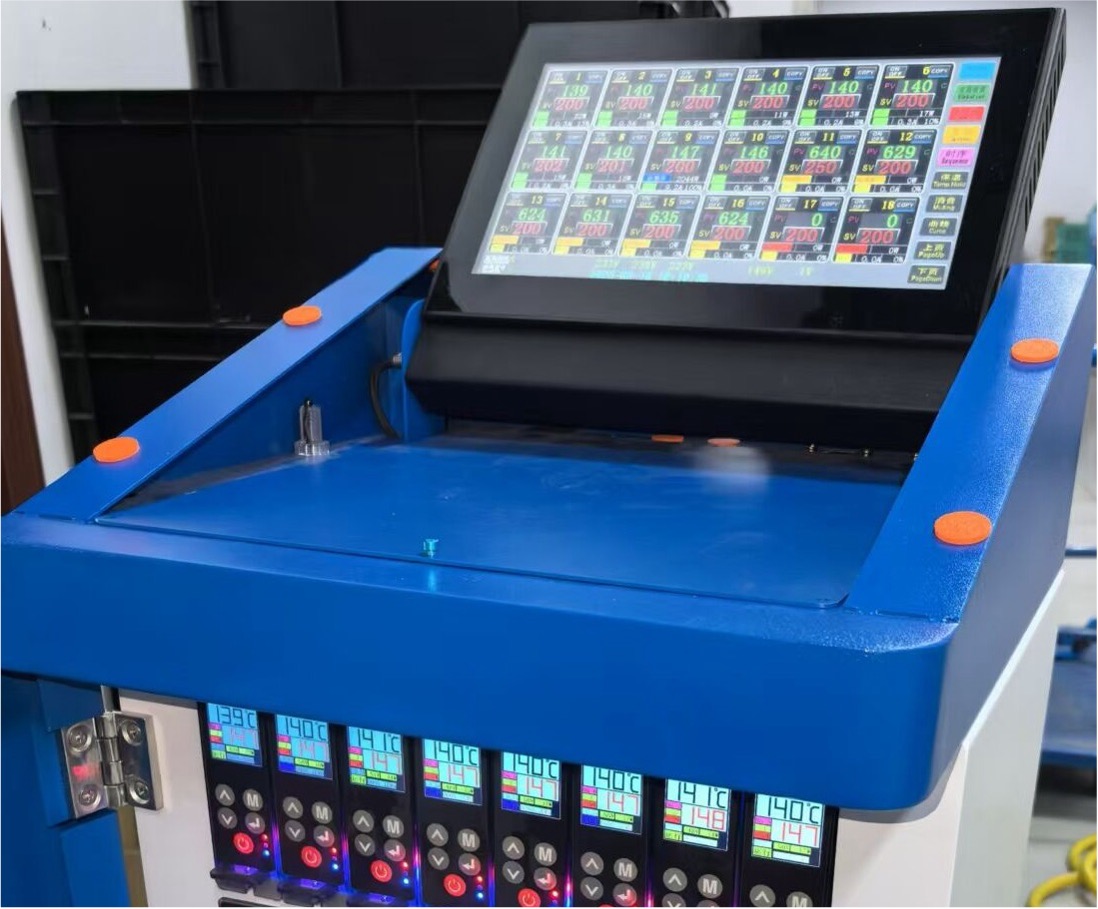
A high-quality hot runner temperature control box is a key device to ensure the stable operation of the hot runner system. Its functional design needs to take into account multiple requirements such as precision, safety, convenience, and compatibility. The following explanation is provided from the dimensions of core functions, auxiliary functions, and extended features:
High-precision temperature control function
1. Precise temperature control and stable output
Many users are concerned about the control accuracy of the temperature control box and may request a control accuracy of ±0.5℃ or even ±0.1℃. However, in actual use, it is known that plastics are amorphous and do not have a fixed melting point. As long as the temperature control accuracy meets the process requirements of the hot runner system, it is sufficient. Considering the current hot runner processing technology and the system consistency of the final product of the hot runner system, it is already very excellent for the hot runner temperature control box to control the temperature accuracy within ±1℃. The claim of ±0.1℃ control accuracy is purely that of an outsider. Currently, there are very few industrial temperature control devices in the world that can achieve a temperature range of 0-500℃ and a control accuracy of ±0.1℃. In addition, the current hot runner temperature control system mainly uses thermocouples to measure temperature. Considering the working characteristics of thermocouples and the variable temperature environment in the injection molding workshop, it is basically impossible to achieve a temperature control accuracy of ±0.1℃.
2. Multi-channel independent control
Supports 8, 16, 32 and other multi-channel temperature control (selectable according to requirements), each channel can independently set temperature, heating power and alarm threshold, meeting the zonal temperature control requirements of complex hot runner systems (such as multi-cavity molds).
The channels are designed with electrical isolation to avoid mutual interference and improve system stability.
Safety protection and fault diagnosis function
1. Multiple safety protection mechanisms
- Over-temperature protection: When the actual temperature exceeds the set value (such as 10℃ or more), the heating power is automatically cut off and an audible and visual alarm is issued to prevent the heating element from burning out or the plastic melt from carbonizing.
- Open-circuit protection: Real-time monitoring of the connection status of the thermocouple (temperature sensor). If a disconnection or poor contact occurs, heating is immediately stopped and the faulty channel is indicated to avoid "false temperature" causing production accidents.
- Overload protection: Built-in circuit breaker and overload protector. When a short circuit or other abnormal current occurs in the circuit, the power is quickly cut off to ensure the safety of the equipment and personnel.
- Fanless normal operation design: The injection molding workshop environment is harsh, and equipment maintenance frequency is low. The cooling fan of the hot runner temperature control box often fails. Therefore, the temperature control box must be able to work in high-temperature environments without equipment failure due to high temperatures, affecting production.
2. Intelligent fault diagnosis and alarm
- Real-time fault display: Through the display screen (such as LCD or touch screen), various control information such as temperature, voltage, power, current, and other fault types (such as over-temperature, open-circuit, heating out of control, etc.) and corresponding channels are displayed intuitively, facilitating quick problem location. In today's information age, using a few LED digital tubes to display alarm information is far from enough. It will greatly affect the production efficiency of injection molding factories.
- Diversified alarm methods: Supports audible and visual alarms (beeper + indicator light), screen pop-up prompts. Some high-end models can transmit alarm information to the PLC or upper computer system through interfaces such as RS485 to achieve remote monitoring.
Convenient operation and humanized design
1. Intuitive human-machine interaction interface
- Graphical display screen: Equipped with a large-sized color touch screen or digital display screen, supporting real-time display of temperature curves, parameter setting (such as temperature, heating time, power percentage), and historical data query.
- Menu-based operation: Simple interface layout, supporting password permission management (distinguishing between administrator and operator permissions) to prevent unauthorized personnel from mistakenly modifying parameters.
2.Flexible parameter setting and storage
- Multiple recipe storage: It can store more than 10 sets of temperature control parameters for different products (such as temperature setting values corresponding to different molds). When changing products, one-click call can be made to reduce debugging time.
- Manual / automatic mode switching: It supports manual adjustment of heating power (suitable for the debugging stage) and automatic PID control (production stage) to meet the needs of different scenarios.
3. Convenient maintenance and debugging functions
- Self-diagnostic test: It supports self-check at startup (checking the circuits and sensor connections of each channel), and some models can manually trigger heating output test, which is convenient for maintenance personnel to troubleshoot hardware faults.
- USB or serial port data export: Temperature data and fault records can be exported to a USB drive or computer for production traceability or data analysis.
High-efficiency energy-saving and compatibility design
1. Energy-saving optimization function
- Intelligent power regulation: Automatically adjust the heating power according to the temperature deviation (such as full power heating at low temperature and gradually reducing the power as the set temperature is approached), reducing energy waste.
- Standby sleep mode: A standby temperature can be set during non-production periods to keep the system in a preheated state while reducing energy consumption.
2. Wide compatibility and expandability
- Compatible with multiple heating elements: Supports various thermocouples (such as J-type, K-type, etc.)
- Communication interface expansion: Standard interfaces include RS485, USB, Ethernet (such as Modbus, TCP/IP protocols), etc., which can be integrated with injection molding machine control systems and MES systems to achieve automated production and remote monitoring.
- Modular design: Some temperature control boxes adopt a modular structure, allowing the number of channels to be increased or decreased according to needs, or faulty modules to be replaced, reducing maintenance costs.
Other auxiliary functions
1. Temperature curve recording and analysis
Real-time recording of temperature change curves for each channel, supporting historical data query (such as temperature fluctuation records for the past 7 days or 1 month), facilitating analysis of production stability or optimization of process parameters.
2. Anti-interference design
- Internal circuits adopt EMC (electromagnetic compatibility) design to reduce the impact of external electromagnetic interference on temperature control accuracy and avoid interference from the equipment itself to other electronic devices.
3. Environmental adaptability
- Capable of wide temperature operation (such as -10°C to 60°C), adapting to temperature fluctuations in factory workshops. Some models also support moisture-proof and dust-proof designs (such as IP54 protection level), extending the equipment's service life.