
Primary role of a hot runner temperature controller
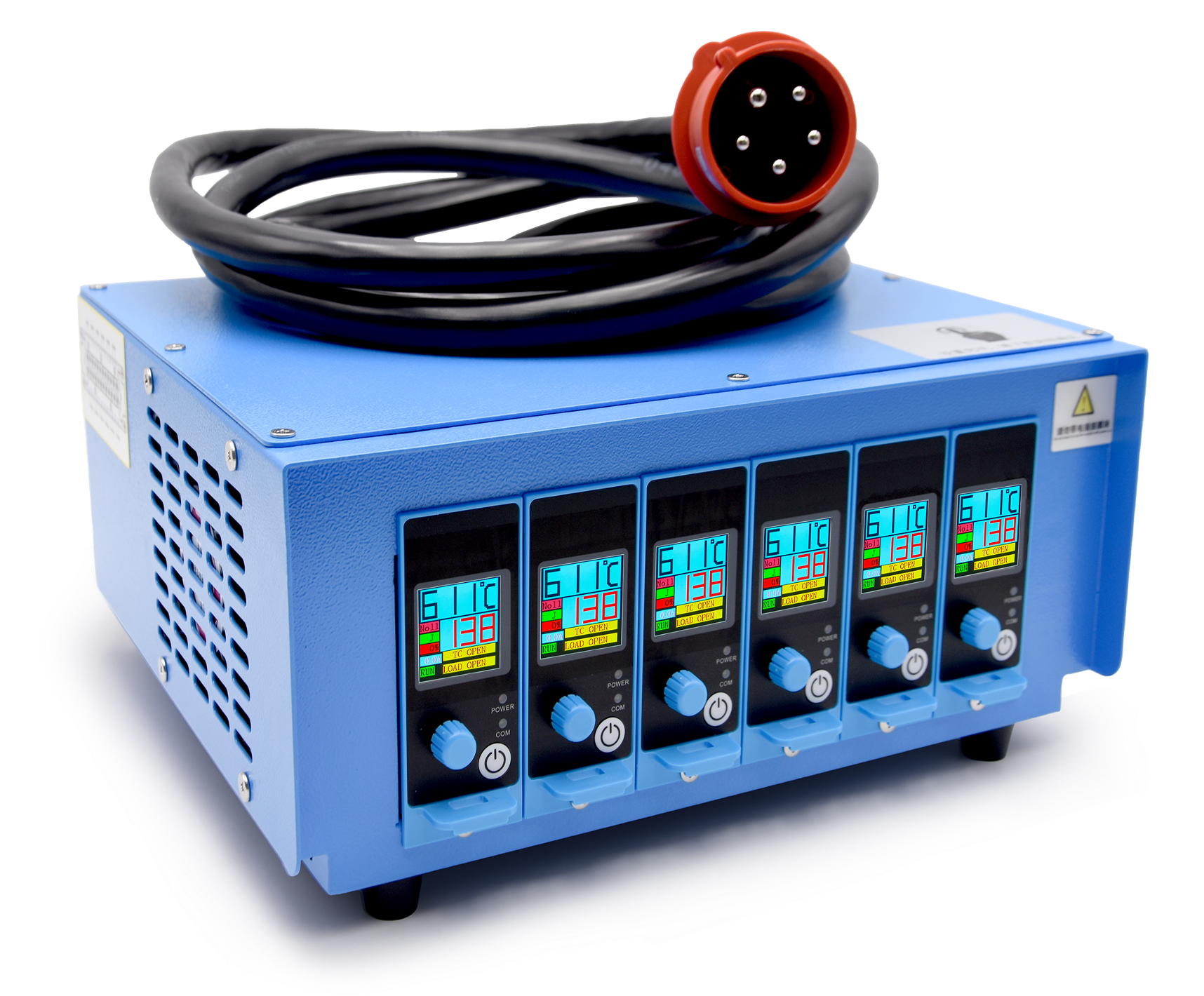
Regulate and stabilize the temperature of the hot runner system, ensuring it remains at the set temperature. Only with a stable temperature can the injection-molded products maintain consistent quality.
First, let’s discuss the common issues encountered during the use of a hot runner temperature controller:
Input Power Supply Failure
Most hot runner temperature controllers operate on a three-phase four-wire 380V power supply, which requires a neutral wire. In practice, many users encounter problems such as missing neutral wires, broken neutral lines, or incorrect wiring between live and neutral wires. In such cases, the internal temperature control unit of the controller may fail to receive a stable AC 220V power supply. If the actual voltage exceeds AC 220V, the internal control unit may be damaged. Therefore, the temperature controller must be able to withstand 380V voltage and provide an alarm alert when such a fault occurs.
Heater Short-Circuit Fault
Short-circuit faults frequently occur during the operation of a hot runner temperature controller, mainly due to heater aging or damaged insulation causing wire-to-wire shorts. When a short circuit happens, the circuit experiences a significant current surge. The temperature controller must be able to withstand this surge without sustaining damage.
Incorrect Connection of Thermocouple and Heater
Due to variations in the heavy-duty plug configurations used by different hot runner system manufacturers, users often face mismatches between the temperature controller’s output and the hot runner system’s input. If the connection is made without verifying compatibility, the temperature controller may burn out the thermocouple. To prevent this, the temperature controller must have an automatic identification function to distinguish between heaters and thermocouples. If a misconnection is detected, the controller should trigger protection mechanisms to prevent thermocouple damage.
Conclusion
To address the three faults mentioned above, a hot runner temperature controller must have the following three essential functions:- 380V Overvoltage Protection
- Heater Short-Circuit Protection
- Thermocouple and Heater Misconnection Detection